
Excessively high reducing agent content
In electroless nickel plating, sodium hypophosphite is almost exclusively used as the reducing agent. The optimal dosage of sodium hypophosphite mainly depends on the concentration of nickel ions. When the pH is above 4, hypophosphite can reduce nickel ions. Typically, 5.4 g of sodium hypophosphite is consumed to deposit 1 g of nickel. When the concentration of this reducing agent is too high, the deposition rate increases, but the bath stability deteriorates.
So, how should the concentration be properly controlled?

When using electroless nickel plating solution, as the pH value continues to rise, the solubility of sodium sulfite decreases. The precipitation of sodium sulfite can potentially lead to bath decomposition. If the pH is further increased, the oxidation reaction of hypophosphite to phosphite changes from a catalytic reaction into a spontaneous homogeneous reaction. At this point, the plating solution decomposes rapidly and becomes ineffective.
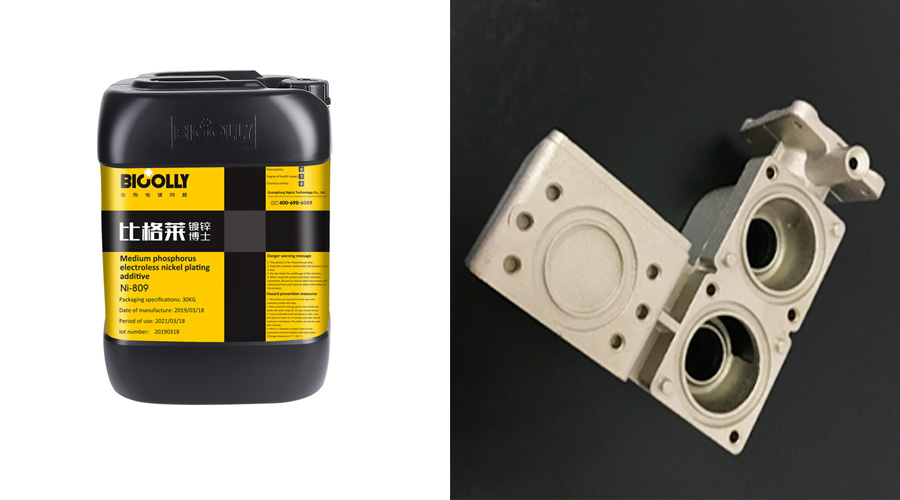
To ensure stable pH during production, Bigely engineers conducted extensive experiments while developing the electroless nickel solution Ni-809. They thoroughly studied the functions and replenishment rules of various additive components, including pH buffers, and formulated a stable commercial concentrated solution. Based on years of large-scale production feedback, Ni-809 not only maintains stable bath pH but also delivers coating performance (such as wear resistance and hardness) that fully meets customer order requirements.
If you are interested in electroless nickel plating solutions, please feel free to contact us at any time.


