Insufficient certain components in the passivation solution
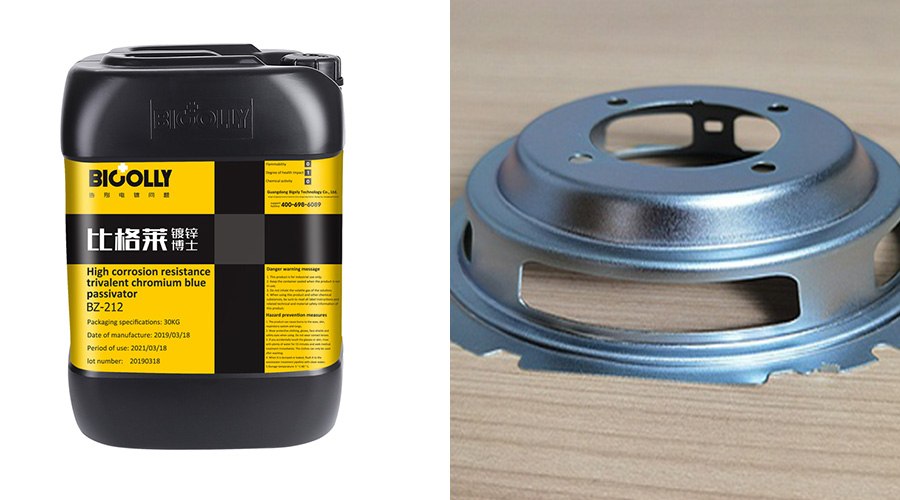
Some components in the trivalent chromium blue-white passivation solution dissolve the zinc layer while also reducing the hexavalent chromium in the passivation solution. Adding these components helps the passivation film present a clear, bright blue-white appearance. If the dosage of these components is insufficient, they cannot form a stable ratio with the trivalent chromium ions, which easily leads to poor brightness of the film layer.
The zinc plating layer itself is not bright
The passivation film is a product formed through the dissolution and film-forming process on the basis of the zinc plating layer. The appearance of the passivation film is closely related to the appearance of the zinc plating layer.
Why is the zinc plating layer not bright? Generally, it is related to the following factors:
① Poor quality of the zinc plating brightener, for example, an outdated formula or a high amount of decomposition products.
② Insufficient plating time, resulting in a coating that is not thick enough, leading to poor brightness. To pursue higher brightness, some electroplating factories choose to extend the plating time.
③ The plating solution is contaminated by metal impurities. We have discussed these in previous articles; interested readers can check them out.
③ The plating solution is contaminated by metal impurities. We have discussed these in previous articles; interested readers can check them out.
How to avoid this phenomenon
In actual production, there are many reasons for poor brightness of the trivalent chromium blue-white passivation film layer. In addition to the two mentioned above, it may also be due to the passivation solution temperature being too high, or the concentration of other components in the passivation solution being insufficient. This is a headache for many electroplating factories: the film is not bright—it could be reason A, reason B (or even C, D), or A+B. Which one should be checked first? Spending several hours checking A might waste time, but if you skip A and check B directly, what if it is actually A?
If you choose a mature-formula trivalent chromium blue-white passivation solution such as Zn-98, can you eliminate the possibility of imbalanced component ratios in the passivation solution? Then the remaining possibilities will be faster to troubleshoot.
Mr. Wu from Guangzhou previously used a self-prepared passivation solution, but when problems occurred he could not solve them in time, which delayed production and required compensation for customer losses. Later, on a friend’s recommendation, he switched to Zn-98. Not only did the product yield rate greatly improve, but even when faults occurred he could get timely support from our engineers, increasing monthly profits by 50,000 yuan.If you are interested in trivalent chromium blue-white passivation solution, please feel free to contact us.