
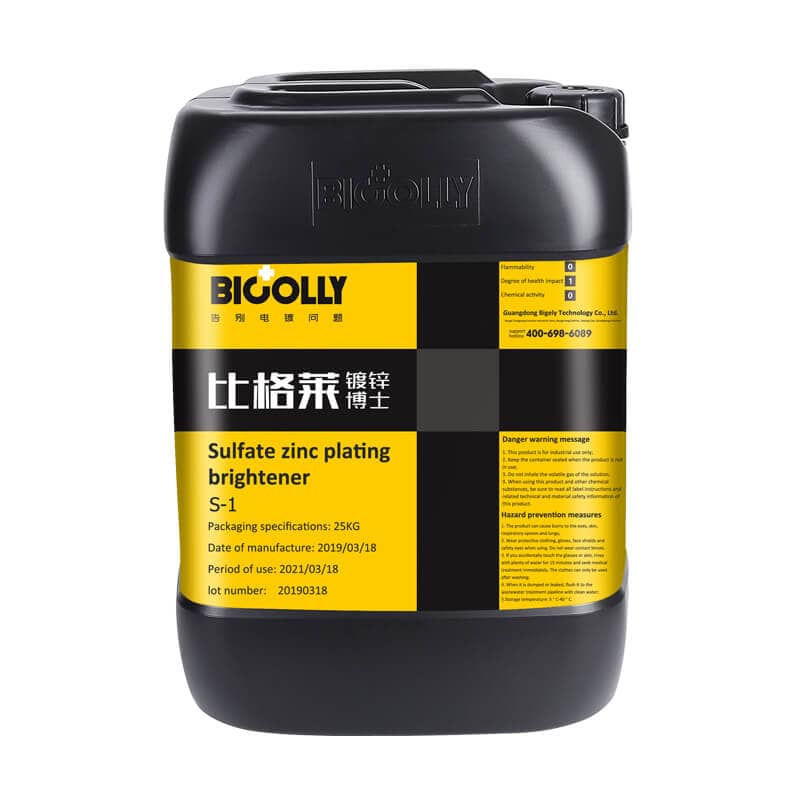
During the application of potassium chloride zinc brightening agent, sometimes the following phenomenon occurs: the current cannot be increased, while the coating easily burns. How should this situation be addressed?
Based on field experience and product characteristics, Bigely Technology conducted the following analysis:
Low zinc content, high pH, or insufficient potassium chloride additive in the zinc chloride plating solution can reduce the upper limit of current density, leading to easy burning of the coating.

When this phenomenon occurs, the pH value of the plating solution should be measured first. If the pH value is too high, an appropriate amount of hydrochloric acid can be used to lower the pH value. The zinc content in the plating solution can be determined by titration. If the zinc content in the plating solution is slightly low, the method of increasing the anode area and appropriately reducing the pH value of the plating solution can be used to gradually increase the zinc content. When the zinc content is too low, the method of adding zinc chloride is used to supplement zinc ions
The amount of potassium chloride zinc plating additive in the plating solution can be confirmed through the Hull cell experiment. When the concentration of additives is low, the coating becomes rough, the range of current density is relatively narrow, and the coating color in the low current density area is dark. At this point, adding an appropriate amount of additives to the plating solution can improve the condition of the coating and solve the problem.
Therefore, in the application process of potassium chloride zinc plating brightener, if the current is not turned on properly and the coating is easily burnt, the pH value of the plating solution and the content of potassium chloride zinc plating additive should be measured.


