




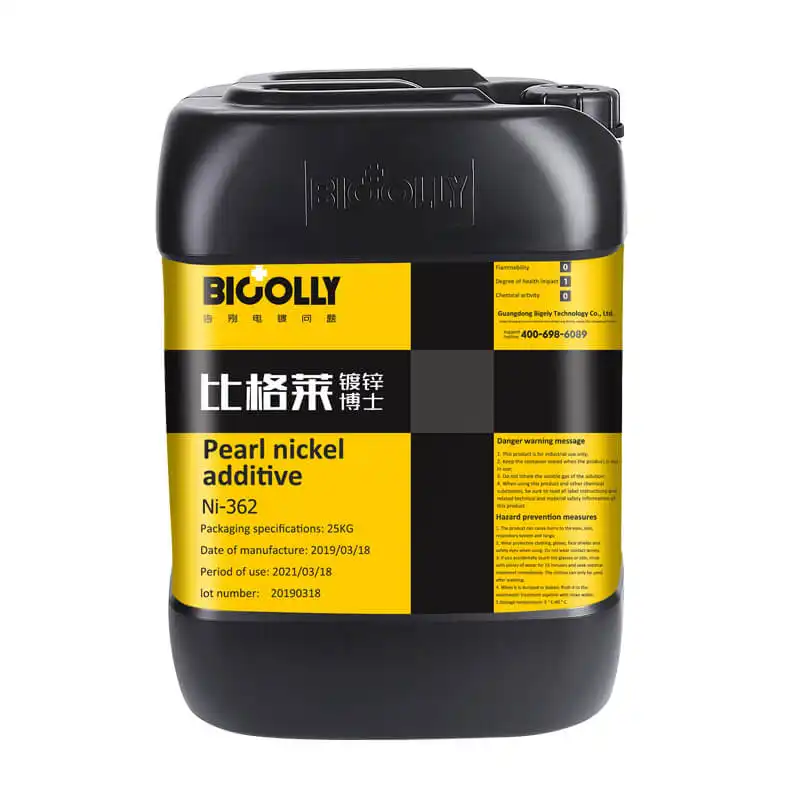


A friend has reported that there have been problems during the production process of using nickel plating brightener. In recent days, the low area coating of the workpieces produced has always been blackened, which has caused headaches due to customer complaints and returns. So what causes the low nickel layer of the workpiece to turn black?
Bigely Technology has conducted an analysis based on on-site experience and product characteristics, mainly focusing on the following four points:
1.The thickness of the nickel layer is too thin. During the production process, the temperature, pH value, and current density of the plating solution should be controlled to avoid the occurrence of gray and black coating after passivation due to the thin coating.

2.Imbalance in the composition of the plating solution. The content of various components in the plating solution is severely imbalanced, such as high nickel sulfate content or low chloride ion content, which leads to poor conductivity of the plating solution and poor dispersion ability, resulting in a thinner coating.
3.Insufficient brightener in the plating solution. Appropriate brighteners can refine the crystallization of coatings, expand the range of bright current density of coatings, and obtain bright, smooth, and low brittle coatings. When the concentration of brightener is insufficient, the brightness of the coating will be poor and there will be blackening phenomenon. The concentration of brightener can be analyzed and adjusted using the Hull cell experiment.
4.The influence of metal impurities. When the content of metal impurities (such as copper and zinc) in the plating solution exceeds the allowable value, the coating in the low current density area will appear dark and black. During the production process, the plating solution can be treated by electrolysis, or the Ni-391 impurity remover from Bigely Technology can be used to treat metal impurities in the plating solution.
Therefore, when the nickel plating layer in the low area of the workpiece turns black, attention should be paid to the above four points, and the fault should be eliminated in a timely manner to reduce the losses caused by the fault, and to better use the rolling nickel plating brightener. If you are interested in nickel plating brightener, please contact Biely customer service for free samples and detailed technical information!


